Commercial Ceiling Fans Buyers Guide
Since 2000, the average cost of electricity in the United States has more than doubled. For business owners who rely on HVAC systems, rising energy costs directly impact operating budgets and long-term facility expenses. Many organizations now use commercial ceiling fans as a cost-effective way to improve thermal comfort and reduce HVAC demand. Selecting the correct fan for a specific application can be challenging, which is why this buyer’s guide is designed to help contractors and facility stakeholders make informed, application-appropriate purchasing decisions.
The U.S. Department of Energy recognizes ceiling fans as one of the most cost-effective comfort strategies for commercial buildings, noting that properly installed ceiling fans can significantly reduce air conditioning demand when used alongside HVAC systems. Actual savings vary based on climate, ceiling height, occupancy patterns, and how fans are integrated into overall building controls.
Residential vs. Commercial Ceiling Fans: What Is the Difference?
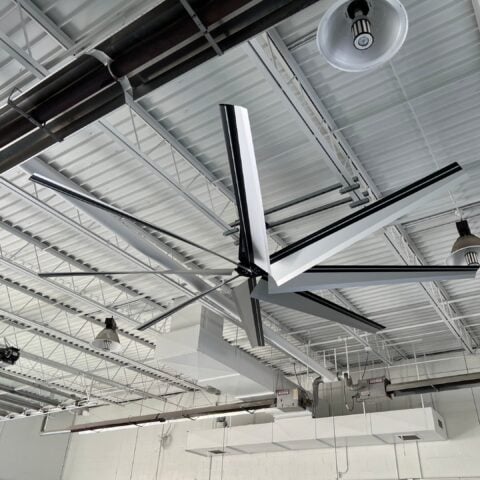
Commercial ceiling fans are engineered for continuous operation, larger spaces, and higher airflow demands than residential models. They prioritize performance, durability, and efficiency over decorative design. These fans typically feature heavier-duty motors, reinforced mounting hardware, and finishes designed to withstand dust, humidity, and variable temperatures. High-volume, low-speed (HVLS) fans represent a specialized category of commercial fans used in large industrial and commercial spaces. These fans commonly range from 8-20 feet in diameter and are available in electrical configurations such as 240V and 480V to accommodate industrial power systems.
How Do Commercial Ceiling Fans Work?
Commercial ceiling fans improve comfort through air movement rather than temperature reduction. By increasing air velocity across occupants, fans enhance evaporative cooling and help reduce perceived temperature. In large spaces, fans also destratify air by pushing warm air down from the ceiling and redistributing it evenly throughout the space. This process helps HVAC systems operate more efficiently by reducing temperature differentials.
For a deeper technical explanation, see our HVLS fan buyer’s guide.

Common Applications for Commercial Ceiling Fans
Commercial ceiling fans are widely used across industries where large floor areas and high ceilings challenge traditional HVAC performance. Warehouses, distribution centers, and manufacturing facilities frequently use fans to supplement cooling and reduce heat buildup. Smaller commercial environments-including retail stores, restaurants, schools, churches, garages, agricultural buildings, and event spaces-also benefit from properly sized fan installations that improve comfort without the expense of full HVAC upgrades.
How Can a Commercial Ceiling Fan Benefit My Business?
- Lower Utility Costs: When integrated with HVAC systems, commercial fans can reduce cooling demand and allow higher thermostat setpoints. Many facilities report 20-30% reductions in HVAC energy usage, depending on climate and operating conditions.
- Improved Air Circulation: Fans promote air movement that helps reduce stagnant conditions and improve overall comfort. While fans do not filter air, improved circulation can support better ventilation strategies.
- Enhanced Working Conditions: Improved airflow helps reduce heat stress and supports safer, more comfortable work environments. Fans assist employers in addressing heat exposure risks outlined in OSHA guidance, though fans alone do not replace required heat safety programs.
- Customer Comfort: In public-facing spaces, moving air reduces stuffiness and creates a more pleasant customer experience.
- Potential Tax Incentives: Energy-efficient commercial ceiling fans may qualify for tax incentives or deductions under current federal or state programs. Eligibility, documentation requirements, and benefit amounts vary and should be confirmed with a tax professional.
Selecting Commercial Fans: Key Factors
Coverage Area
Fan selection begins with understanding the size of the area requiring airflow. As a general planning guideline, one large commercial fan can serve approximately 1,500-2,500 square feet, though ceiling height, obstructions, and airflow goals significantly influence final layouts. Professional airflow planning is recommended for larger or irregular spaces.
Airflow Rates (CFM)
Airflow is measured in cubic feet per minute (CFM). Higher CFM values indicate greater air movement, but effective airflow depends on multiple design factors:
- Blade Pitch: Steeper blade angles generally move more air.
- Blade Count: More blades can increase airflow but may raise noise levels and motor load.
- Motor Capacity: Larger motors support higher torque and airflow demands.
- Sweep Diameter: Larger diameters move broader columns of air, improving coverage.
Fan Dimensions and Mounting Clearances
Fan size must align with available ceiling space and safety requirements. Minimum horizontal and vertical clearances vary by model and application. ENERGY STAR recommends a minimum of 7 feet between fan blades and the floor. Always account for fixed obstructions such as shelving, lighting, or machinery.


Wet and Damp Ratings
Fans installed in outdoor or moisture-prone environments must carry appropriate ratings. UL or ETL wet-rated fans are designed for direct water exposure, while damp-rated models are suitable for covered areas with humidity but no direct water contact. Always match the fan’s rating to the installation environment.
Control and Efficiency Features
Modern commercial fans offer features such as reversible operation for winter destratification, variable speed control, and integration with building management systems. Many facilities select fans with 0-10V control capability for automated adjustment based on occupancy and seasonal demand.
Installation and Maintenance Considerations
Commercial ceiling fan installation is generally less invasive and more cost-effective than HVAC upgrades, but proper structural support and electrical design are critical. Installation should be performed by qualified professionals familiar with load requirements and local electrical codes.
- Disconnect power at the source.
- Install properly rated junction boxes and mounting hardware.
- Secure the fan to approved structural supports.
- Complete electrical connections and control wiring.
- Restore power and verify operation.
Maintenance Requirements
Most modern commercial fans require minimal maintenance. Routine visual inspections help identify loose fasteners, blade damage, or wiring issues. Maintenance needs vary by model-many newer fans use sealed bearings and do not require lubrication. Always follow manufacturer-specific maintenance guidelines.
Expert Support for Commercial Fan Selection
Our product specialists assist contractors and facility managers with fan selection, airflow planning, and energy savings analysis. We provide application-specific recommendations, verify electrical compatibility, and support compliance with installation requirements. This consultative approach helps ensure your commercial fan investment delivers measurable comfort and efficiency benefits over the long term.